
13
Oct
2026
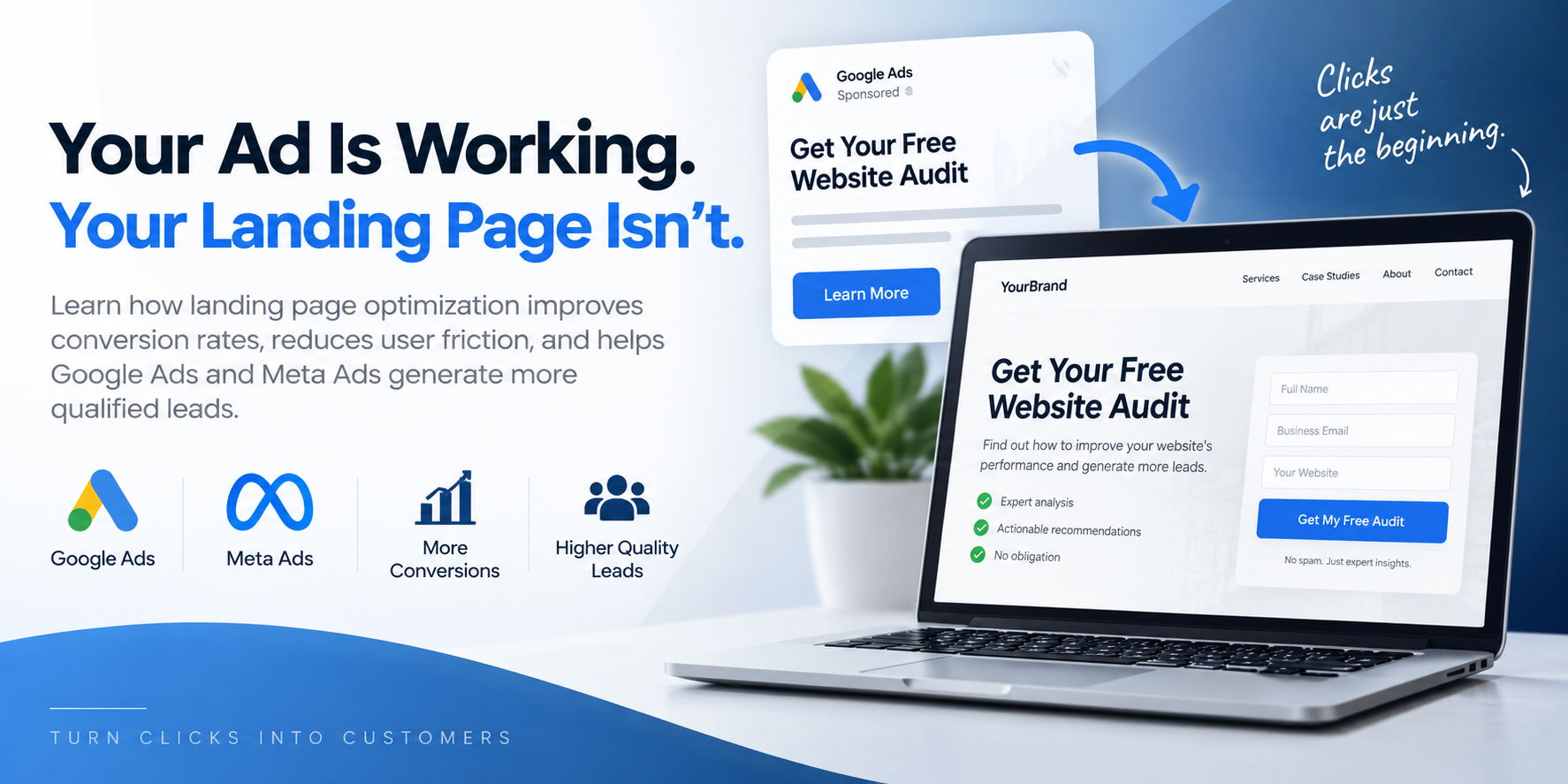
You have invested in Google Ads and Meta Ads. Your campaigns are reaching the right audience, people are clicking on your ads, and traffic is coming to your website. But there is one problem: the enquiries are not coming in.
So, what is going wrong?
Before increasing your advertising budget or changing your entire campaign strategy, take a closer look at your landing page. A successful ad campaign does more than attract attention. It brings potential customers to your business. Your landing page must then convince them to take the next step. If visitors leave without enquiring, signing up, or making a purchase, your advertising budget may not be delivering the results you expected.
This is where Landing Page Optimization makes a difference. By improving the content, design, user experience, and conversion journey, businesses can turn more of their existing traffic into meaningful opportunities.
What Is Landing Page Optimization?
Landing Page Optimization is the process of improving a webpage to encourage visitors to complete a specific action. This could mean filling out a lead form, booking a consultation, purchasing a product, or requesting a quote. Unlike a regular website page that serves multiple purposes, a landing page is designed around a clear goal. For example, if your Google Ads campaign promotes digital marketing services, sending visitors to a general homepage may leave them searching for the service they clicked on. A dedicated landing page that explains your services, highlights relevant benefits, and offers a clear way to enquire creates a more direct journey. The objective is simple: help visitors find what they came for and make it easier for them to take action.
5 Reasons Your Landing Page Is Losing Potential Customers
1. Your Ad Promise and Landing Page Do Not Match
Imagine someone clicks on a Meta Ad offering a free website audit. Instead of seeing the promised offer, they land on a generic services page. The visitor now has to search for the information they expected to find immediately. That disconnect can create confusion and reduce the likelihood of conversion. Your landing page should continue the conversation your ad started. Keep the headline, offer, messaging, and call to action consistent with the advertisement.
What to do: Match your landing page headline to the specific offer or service promoted in your Google Ads or Meta Ads campaign.
2. Your Page Has Too Many Distractions
A landing page does not need to explain everything about your business. Its primary purpose is to guide visitors towards one meaningful action. Too many navigation links, competing offers, lengthy paragraphs, and unnecessary pop-ups can distract visitors from the main objective.
What to do: Keep the layout focused. Use a clear headline, concise supporting content, relevant visuals, and one prominent primary call to action.
3. Your Call to Action Is Not Convincing
A visitor might be interested in your services but still hesitate if the next step is unclear. Generic buttons such as “Submit” or “Click Here” do little to explain what happens next. A specific call to action sets clearer expectations and helps visitors make a decision.
What to do: Use action-oriented language that communicates the value of taking the next step.
For example:
● Instead of “Submit”, use “Get Your Free Consultation”.
● Instead of “Contact Us”, use “Discuss Your Project”.
● Instead of “Learn More”, use “Explore Our Services”.
Make sure the call to action accurately reflects the offer and what your business can deliver.
4. Your Landing Page Is Difficult to Use on Mobile
Many potential customers discover businesses through their smartphones. If your landing page loads slowly, displays poorly on smaller screens, or requires visitors to zoom in to read the content, you risk losing their interest. A complicated mobile experience can create unnecessary friction, even when the advertisement itself is effective.
What to do: Optimise your page for mobile devices. Compress heavy images, simplify forms, make buttons easy to tap, and ensure that important information appears near the top of the page. A smooth experience helps visitors move from interest to action without unnecessary effort.
5. You Are Asking for Too Much Information
Your business may need detailed information to qualify a lead. However, asking visitors to complete a long form before they understand your value proposition can discourage them from enquiring. Every additional field should serve a clear purpose.
What to do: Start with essential information, such as name, business email, and the specific detail required to respond to the enquiry. Ask for additional information later when necessary. The goal is to make the first step easy while maintaining the quality of the leads your business receives.
How Landing Page Optimization Improves Conversion Rate Optimization
Conversion Rate Optimization (CRO) focuses on increasing the percentage of visitors who complete a desired action. Landing Page Optimization is an important part of that process. Instead of spending more to attract additional traffic, businesses can investigate why existing visitors are not converting and improve the experience accordingly.
Here is how the process works:
Step 1: Identify the problem. Analyse landing page visits, form submissions, conversion rates, and user behaviour to understand where visitors drop off.
Step 2: Review the user journey. Check whether the page fulfils the ad's promise, communicates the offer clearly, and makes the next step obvious.
Step 3: Improve the experience. Refine headlines, simplify forms, strengthen calls to action, improve mobile usability, and remove unnecessary distractions.
Step 4: Test your changes. Compare different headlines, layouts, or calls to action through controlled tests wherever possible.
Step 5: Measure meaningful results. Track completed enquiries, qualified leads, purchases, and cost per lead rather than judging performance by clicks alone.
Effective CRO is not about changing a page based on assumptions. It is about using data to identify opportunities and testing improvements to understand what works for your audience.
Google Ads vs. Meta Ads: Does Your Landing Page Need a Different Approach?
Yes. Although both platforms can drive traffic to your website, visitors may arrive with different levels of intent.
Landing Pages for Google Ads
People using Google Search often have a specific requirement in mind. They may be actively searching for a service, comparing providers, or looking for a solution to an immediate problem.
Your landing page should address that intent directly.
● Use headlines that reflect the search query and advertised service.
● Explain your offering and its benefits clearly.
● Provide relevant proof, such as genuine testimonials or case studies.
● Make it easy to request a quote, book a consultation, or make a purchase.
Landing Pages for Meta Ads
People clicking on Facebook or Instagram advertisements may not be actively searching for your product or service. They might discover your business while browsing their feeds. Your landing page may need to build interest and trust before asking them to take action.
● Reinforce the benefit communicated in the creative.
● Explain why the offer is relevant to the visitor.
● Use engaging visuals and concise, persuasive content.
● Address common concerns before presenting the primary call to action.
Regardless of the platform, the landing page must deliver what the advertisement promises. The difference lies in how much context and reassurance your audience needs before converting.
How to Measure the Success of Landing Page Optimization
A landing page should be evaluated by its contribution to business goals, not simply by its appearance. The following metrics can help you assess its performance:
1. Conversion Rate: The percentage of landing page visitors who complete the desired action.
2. Cost Per Lead: The advertising spend divided by the number of leads generated, using a consistent attribution and measurement approach.
3. Lead Quality: The proportion of enquiries that match your target audience and have a realistic potential to become customers.
4. Form Completion Rate: The percentage of visitors who start a form and successfully complete it, when this behaviour is tracked.
5. Page Engagement: Metrics such as engagement time and scroll behaviour can help identify whether visitors are interacting with the content.
6. Return on Advertising Spend: For campaigns with reliable revenue tracking, this helps evaluate the revenue attributed to advertising relative to the advertising spend.
Review these metrics alongside campaign data. A low conversion rate may indicate a landing page issue, but it can also reflect audience targeting, offer relevance, pricing, or traffic quality. Analysing the complete journey helps you identify the real problem.
How Magic Pencil Helps Turn Clicks into Conversions
At Magic Pencil, we believe that successful digital marketing goes beyond driving traffic. It is about creating meaningful customer journeys that encourage people to take action. Whether you are running Google Ads or Meta Ads, your landing page plays a crucial role in determining what happens after someone clicks on your advertisement. A relevant message, intuitive design, compelling copy, and clear call to action can make the difference between a visitor who leaves and a potential customer who enquires.
Our approach focuses on aligning your advertising strategy with your landing page experience. From understanding audience intent and refining messaging to improving page structure and identifying conversion opportunities, we help businesses build a more effective digital presence. By bringing together creative thinking, strategic planning, and performance-focused digital marketing, Magic Pencil helps businesses identify gaps in their customer journey and explore opportunities to improve lead generation. The goal is to make every part of your digital marketing work towards a common objective: connecting the right audience with the right message and making it easier for them to take the next step.
Conclusion: Your Ads Deserve a Landing Page That Converts
Your advertisements may be attracting the right audience, but if your landing page fails to meet their expectations, you could be losing valuable business opportunities. Before increasing your advertising budget, evaluate your landing page. Is your message clear? Does your page deliver on the promise made in your ad? Is the next step simple enough for visitors to take?
Effective Landing Page Optimization helps address these gaps by creating a smoother user experience, strengthening your messaging, and making conversions easier. When combined with a well-planned Conversion Rate Optimization strategy, it can help businesses make better use of their existing traffic and improve their lead generation efforts.
At Magic Pencil, we believe that digital marketing success is about more than clicks, impressions, and website visits. It is about building a connected strategy where advertising, content, and user experience work together to support meaningful business outcomes. Because when your ad gets attention, your landing page should turn that attention into action.
Ready to turn more clicks into customers? Connect with Magic Pencil and discover how a more conversion-focused digital marketing strategy can help your business move forward.
Get in Touch